Key Takeaways
- Structural Weakness: Large co-dominant stems often create weak unions that are more likely to fail in storms, wind, or heavy loading.
- Included Bark Risk: Bark growing between the stems can prevent strong wood attachment and trap moisture that leads to decay.
- Mature Trees Are Vulnerable: As trees grow larger, the stress on these unions increases and the failure risk rises.
- Prevention Matters: Structural pruning when trees are young is the best way to reduce co-dominant stem problems later.
- Professional Evaluation Helps: Certified arborists can determine whether a tree needs pruning, cabling, bracing, or removal.
Trees with a strong, single central leader are usually more stable than trees with multiple large stems competing for dominance. When mature trees develop co-dominant stems, the structure can become weak in exactly the place that is supposed to hold the canopy together. That weak point often becomes a major failure risk during storms, high winds, ice loading, or long periods of stress.
For homeowners, property managers, and anyone responsible for large trees, understanding co-dominant stems matters because the problem can remain hidden for years. A tree may look healthy overall while still carrying a serious structural defect in the trunk union. Once those stems grow large, the risk becomes harder and more expensive to correct.
This article explains why large co-dominant stems are so dangerous, what warning signs to look for, and why professional tree care is often the safest solution. If you know how to spot the risk early, you can protect people, buildings, vehicles, and the tree itself.
What Co-Dominant Stems Are
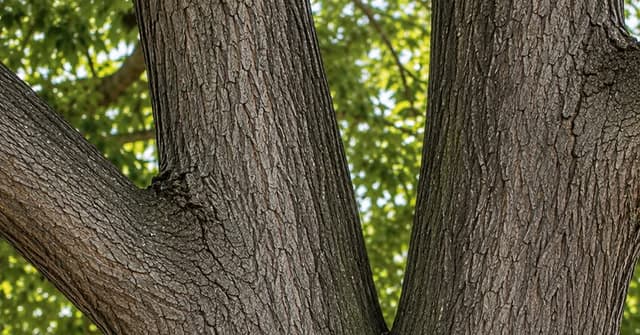
Co-dominant stems are two or more main stems that grow from the same point and compete for dominance. Instead of one strong central leader, the tree develops a split trunk or a tight V-shaped union. Over time, the stems can grow nearly equal in size, which makes the attachment even more problematic.
This structure is common in many mature trees, especially when the tree was not pruned properly in its younger years. Once the stems become large, the union can no longer be treated as a small structural issue. At that point, the tree may already be carrying a major defect that could fail under stress.
Why the Union Is Weak
The main problem with co-dominant stems is that the attachment often lacks the strong wood support found in a single dominant trunk. Instead of one stem growing through and supporting the structure, two stems press against each other and compete. That competition creates a weak junction that may not handle heavy loads well.
In many cases, the angle between the stems is narrow and V-shaped rather than broad and supportive. This creates a mechanical flaw that becomes more dangerous as the tree matures. The larger the stems grow, the greater the leverage and strain on the union.
Included Bark Makes It Worse
One of the most serious issues with co-dominant stems is included bark. This happens when bark grows inward between the two stems instead of allowing the wood to fuse properly. Included bark prevents the stems from locking together in a strong way. Because bark is not structural wood, it weakens the union and can trap moisture, debris, and decay-causing organisms. That moisture can lead to rot, and rot can further reduce the strength of the attachment. A co-dominant stem with included bark is often much more likely to fail than a similar tree with a stronger branch union.
Mature Trees Face Greater Risk
A small co-dominant stem problem in a young tree may not be urgent if it is corrected early. But when the stems have grown large, the situation becomes more dangerous because the tree is now carrying far more weight. The force of the canopy, along with wind and storm stress, is concentrated on that weak point.
As mature trees increase in size, the leverage on the union becomes greater. That means even a tree that appears healthy and stable can split suddenly if the stems are large enough and the attachment is weak enough. This is why mature trees with co-dominant stems are considered one of the biggest failure risks in arboriculture.
Storms Put Extra Stress on the Tree
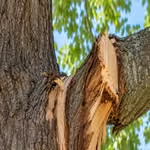
High winds, ice accumulation, and heavy rain all increase the stress on weak unions. When a tree sways during a storm, the co-dominant stems may move independently, placing pressure on the point where they meet. If included bark or decay is already present, that movement can lead to sudden splitting.
Even if the tree does not fail immediately, repeated storm stress can make the defect worse over time. A tree that survives one storm may be closer to failure after the next one. That is why arborists treat large co-dominant stems as a safety concern, especially on trees near homes, driveways, sidewalks, and outdoor living areas.
The Warning Signs to Watch
There are several signs that a tree may have dangerous co-dominant stems.
- A tree with two large upright stems that meet at a narrow angle is the most obvious one.
- Cracking at the union, bark splitting, or visible seams between the stems are also serious warning signs.
- You may also notice the tree leaning unevenly, showing response growth, or producing dead wood near the weak area.
- In some cases, the defect is visible only from a close inspection by a trained arborist. If the tree stands over a house, garage, or parked vehicle, the risk is even more important to assess.
Why Homeowners Should Not Ignore It
People often assume a mature tree is strong simply because it has survived for many years. But co-dominant stems can remain a hidden defect until the moment of failure.
- A tree can look full of leaves and still be structurally unsafe. Ignoring the problem can lead to major property damage or injury if the tree splits during a storm.
- The cost of prevention is usually far lower than the cost of tree removal, roof repairs, or cleanup after a collapse.
- In tree care, the most dangerous defects are often the ones that appear stable until they fail.
How Arborists Evaluate the Risk
- A certified arborist in Evansville, Indiana will first inspect the size, angle, and condition of the stems.
- They will look for included bark, cracks, decay, dead branches, and signs that the union is moving under stress. The tree’s location also matters, especially if it stands near people or structures.
- The arborist may recommend pruning, cabling, bracing, or removal depending on the condition of the tree.
- If the stems are too large and the union is already compromised, removal may be the safest option.
- If the tree still has acceptable structure, support systems may reduce movement and lower the risk of failure.
Can the Problem Be Prevented?
The best time to prevent co-dominant stems is when the tree is young. Structural pruning can help establish a strong central leader and reduce the chance that two stems will compete. Once the tree matures, correcting the defect becomes more difficult.
Proper early pruning, species selection, and regular inspections go a long way toward preventing these failures. Homeowners who plant and maintain trees carefully from the start are less likely to face major structural issues later. Prevention is much easier than trying to fix a large defect in a mature tree.
Why Mature Trees Need Careful Decisions
Mature trees with large co-dominant stems can sometimes be saved, but not always. The decision depends on the tree’s overall health, its value in the landscape, and the level of risk it presents. A tree over a structure demands a much more cautious approach than one in an open yard. Sometimes the safest choice is removal, especially if decay, cracking, or storm damage is already present. In other cases, ongoing monitoring and structural support may be enough. The right answer comes from a professional evaluation, not guesswork.
Tree B-Gone provides professional tree care with a focus on safety, structural risk, and property protection. Our team understands how dangerous large co-dominant stems can be on mature trees. We offer expert inspections to identify weak unions, included bark, and signs of failure before problems become emergencies.
Tree B-Gone can recommend the right solution, whether that means pruning, support, or full removal. Our crew work carefully around homes, garages, fences, and landscapes to reduce damage during service. Homeowners trust them for clear communication, reliable scheduling, and professional cleanup. When a tree becomes unsafe, Tree B-Gone is ready to help protect your property. Call Tree B-Gone at (812) 714-1217 to schedule a tree safety evaluation and get expert guidance.
Frequently Asked Questions About Large Co-Dominant Stems in Evansville, IN
Are co-dominant stems always dangerous?
Not always, but they are inherently weaker than a strong central leader. The risk becomes much greater when the stems are large, included bark is present, or the tree is near a target.
Can cabling fix co-dominant stems?
Cabling can reduce movement and help support the structure in some cases, but it does not make the tree permanently safe. An arborist must decide whether support is appropriate.
Should a mature tree with co-dominant stems always be removed?
No. Some trees can be managed with pruning or structural support, but others are too risky to keep. The final decision depends on the defect, tree health, and location.
How can I tell if my tree has included bark?
Look for a narrow V-shaped union where the stems meet. If bark appears trapped inside the junction or the stems look pressed together rather than fused, included bark may be present.
Can young trees be trained to avoid this problem?
Yes. Structural pruning when the tree is young is the best way to encourage a strong central leader and prevent future co-dominant stems.
Summary Checklist: Structural Hazards and Failure Risks
| Condition | Risk Level | Recommended Action |
| Cracks or splitting | Critical | Consider urgent removal or support |
| Tree over structure | Critical | Get a professional safety evaluation |
| Included bark at union | Very High | Assess for failure risk immediately |
| Large co-dominant stems | High | Schedule an arborist inspection |
| Storm exposure | High | Inspect before and after severe weather |
Final Advice
Large co-dominant stems should never be treated as a minor cosmetic issue. They create a structural weakness that can lead to sudden failure in mature trees, especially during storms or periods of heavy stress. If the tree is near your home, driveway, or any other valuable target, the risk becomes even more serious. A certified arborist can help you determine whether the tree should be pruned, supported, monitored, or removed. Acting early gives you more options and helps protect both your property and the tree. In tree care, large co-dominant stems are one of the clearest examples of a hidden defect that deserves immediate attention. Call Tree B-Gone at (812) 714-1217 to schedule a tree safety evaluation and get expert guidance.