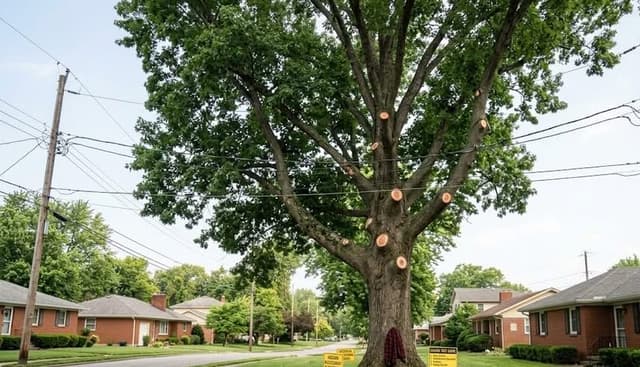
Homeowners in Evansville can usually remove trees on their property, but trees located within utility easements or near power lines may require coordination with the utility company. Before removing a tree, verify easement boundaries and contact Indiana 811 before any digging or stump grinding.
Key Takeaways
- A utility easement gives a utility company the legal right to access and maintain its infrastructure on your property, even though the land remains yours.
- Trees in or near utility easements are a frequent source of confusion: the homeowner often owns the tree but does not have unrestricted authority to remove it without coordinating with the utility, especially when overhead lines or buried infrastructure are involved.
- Indiana law requires anyone digging on property to call 811 (or use the Indiana 811 online portal) at least two full working days before digging to have buried utilities marked. This applies to stump grinding as much as to removal.
- Attempting tree removal near overhead electrical lines without proper coordination is one of the most dangerous things a homeowner can do. Electrocution risk includes induced current, which means contact is not required for serious injury.
- Most utilities in the Tri-State area will trim or remove damaged trees that directly threaten their lines free of charge, but the work follows utility standards rather than aesthetic preferences, which is often a surprise to homeowners..
This guide walks through how utility easements work in Evansville and the surrounding Tri-State, who owns and controls trees within them, what coordination is required before any removal, and how to avoid the costliest and most dangerous mistakes.
Can You Remove a Tree in a Utility Easement in Evansville?
Yes, homeowners can usually remove trees on their property, but if the tree is located inside a utility easement or near power lines, utility company coordination may be required. Before removing the tree, verify easement boundaries, contact the utility provider if necessary, and call Indiana 811 at least two working days before digging or stump grinding.
What Is a Utility Easement on Your Property?
A utility easement is a legal right granted to a utility company that allows the utility to install, access, and maintain its infrastructure on private property. The land remains owned by the property owner. The utility’s rights are limited to its specified use, but those rights are real and enforceable.
Easements in the Evansville area commonly cover:
- Overhead electrical service lines: The lines running from poles to your house and the connecting distribution lines
- Underground electrical lines: Common in newer subdivisions where service is buried
- Natural gas service lines: Both main lines and service drops to individual homes
- Water and sewer mains: Often located in front or side yard easements
- Communications infrastructure: Telephone, cable, and fiber optic lines, often buried alongside electrical
- Drainage easements: Sometimes overlapping with utility easements
The easement is typically a defined strip of land, often 10 to 15 feet wide, along the front, back, or side of the property. The exact location and dimensions are documented in the property’s deed or recorded plat. A title search reveals existing easements on any property.
Who Owns Trees in a Utility Easement?
This is the most common point of confusion. A tree growing within a utility easement on private property is generally owned by the property owner. The utility company does not own the tree.
However, ownership of the tree does not mean unrestricted authority over it. The utility has the legal right to:
- Trim or remove trees that interfere with its infrastructure or maintenance access
- Conduct vegetation management as needed to protect service reliability
- Enter the easement to perform this work without requiring permission from the property owner
The utility’s authority to address trees in the easement does not extend to trees outside the easement. A tree growing on your property outside the documented easement is fully under your control, subject to local ordinances and other property-specific factors.
Why Tree Removal Near Power Lines Is Dangerous
Most utilities in the Tri-State area, including the major electric and gas providers serving Evansville and the surrounding counties, operate ongoing vegetation management programs. These programs follow utility industry standards that prioritize service reliability and worker safety.
The result is often surprising to homeowners:
- Utility trimming follows utility patterns: The cuts are designed to keep growth away from lines, which can produce shapes that look unusual compared to aesthetic pruning
- Removal happens when trimming cannot maintain adequate clearance: Trees that have grown into power lines and cannot be safely pruned to clearance are removed
- The utility decides timing: Routine vegetation management happens on the utility’s cycle, not the homeowner’s schedule
- Storm response is reactive: During major outages, utility crews focus on restoring service first, and then address trees that caused the outage during cleanup
- The work is typically free to the homeowner: When the utility performs the work for its own infrastructure protection, the homeowner is not billed
A homeowner who wants the work done differently, sooner, or with different cut patterns is generally responsible for hiring a private tree service that can coordinate with the utility.
Tree Removal Responsibility Guide
| Situation | Homeowner Responsibility | Utility Involvement |
| Tree outside easement | Full responsibility | Usually none |
| Tree inside easement | Usually homeowner-owned | Coordination may be required |
| Tree touching power lines | Do not remove yourself | Utility involvement required |
| Stump grinding | Call 811 first | Utility marking may be needed |
When Homeowners Need Utility Coordination
For trees near power lines that the utility has not flagged for its own action, or for trees where the homeowner wants removal that goes beyond what the utility would do, the homeowner hires a private tree service. This is where coordination becomes important.
Notification of the Utility
For work near overhead electrical lines, the utility may need to:
- De-energize the line during the work
- Install protective sleeves on conductors
- Have a utility line clearance crew handle the work in proximity to the lines
- Coordinate the timing to minimize service disruption
Most utilities require notification of planned work near their lines, typically with several business days of lead time. The tree service handles this coordination on the homeowner’s behalf in most cases.
Calling 811 Before Stump Grinding or Excavation
Indiana law requires anyone planning to dig on property to contact Indiana 811 at least two full working days before digging. This includes stump grinding, root excavation, and any work that breaks ground. The notification triggers utility marking of buried lines so they can be avoided during the work.
Calling 811 is free and provides legal protection if a utility line is hit during work that was properly marked. Skipping the call exposes the homeowner to significant liability and damage costs.
Working Around Buried Infrastructure
Buried lines are often closer to the surface than homeowners expect. Stump grinders routinely penetrate 12 inches or more below grade. Roots can disturb buried lines during removal. A professional crew should always verify marked utility locations before grinding and should use techniques appropriate for the marked utilities present.
The Danger of DIY Near Power Lines
Tree work near energized power lines is one of the most dangerous activities possible on residential property. The risks include:
- Direct contact electrocution: A tool, ladder, or branch touching an energized line produces immediate severe injury or death
- Induced current: Electricity can arc through air from a high-voltage line to a nearby conductor, including a chainsaw or pole pruner, without direct contact
- Falling branches into lines: A branch dropped into a power line creates a hazard for everyone in the area
- Backyard secondary lines: Service drops carrying 240 volts can still cause serious injury or death
Utility line clearance work is performed only by specially trained crews using insulated equipment. Homeowners and general tree services without line clearance training should never attempt work in the line proximity zone (typically defined as 10 feet from any energized conductor for general tree workers).
What We Commonly See In The Field
The most common pattern is the homeowner who calls for tree removal without realizing that the tree sits in a utility easement, and who is surprised when coordination with the utility adds time to the project. The frustration is understandable but the coordination is not negotiable.
The second pattern is the stump grinding job where the homeowner did not call 811 because the original tree did not seem to be near anything underground. The grinder hits a buried service line, the work stops, and a multi-thousand-dollar repair becomes the homeowner’s responsibility because the call was not made.
The third pattern is the DIY attempt near power lines, often after a small storm has dropped a limb across or near a service drop. The homeowner climbs a ladder with a pole saw to address the limb without realizing the limb is in contact with the conductor or close enough to arc.
What Evansville Homeowners Can Do Right Now
- Identify the easements on your property by reviewing your deed or property records
- Locate overhead power lines, buried utility marks, and other infrastructure visually before authorizing any tree work
- Call 811 at least two full working days before any excavation, including stump grinding
- Coordinate with the utility for any work within the line proximity zone or directly under power lines
- Hire only tree services that carry general liability insurance and workers’ compensation, with certificates verifiable directly from the insurance carrier
Do I Need Permission From the Utility to Remove a Tree on My Property?
If the tree is outside a utility easement and not near overhead power lines, utility permission is generally not required. If the tree is inside an easement or close to utility infrastructure, coordination with the utility company may be necessary before removal.
Will the Utility Remove a Tree Threatening Power Lines for Free?
In many cases, utility companies perform vegetation management at no cost when a tree threatens electrical service or utility infrastructure. The work is completed according to utility safety standards rather than homeowner preferences.
How Do I Know If a Tree Is in a Utility Easement?
Check your property survey, subdivision plat, deed records, or county property records. Utility easements are usually identified as designated areas where utility companies have legal access to maintain infrastructure.
Do I Need to Call 811 Before Stump Grinding?
Yes. Indiana law requires property owners and contractors to contact Indiana 811 at least two full working days before any digging activity, including stump grinding and root excavation. Utility marking helps prevent costly damage to buried lines.
What Happens If I Hit a Buried Utility Line During Tree Work?
Damaging a buried utility line can result in expensive repairs, service interruptions, and liability for the homeowner or contractor. Calling 811 before excavation helps reduce risk and provides important legal protections.
What Should I Do If a Tree Falls on a Power Line?
Stay away from the tree, the power line, and anything touching either. Assume the line is energized and immediately contact the utility company. Never attempt to remove branches or debris from power lines yourself.
Call Tree-B-Gone Before Tree Work Near Utility Easements
Removing a tree near power lines, utility easements, or buried utility infrastructure requires proper planning and coordination. Before any tree removal, stump grinding, or excavation begins, verify easement boundaries, contact Indiana 811, and coordinate with the appropriate utility company when necessary. Taking these steps helps prevent property damage, service interruptions, costly repairs, and serious safety hazards.
Tree-B-Gone provides professional tree removal, utility easement tree services, utility coordination assistance, and 811-compliant stump grinding throughout Evansville, Newburgh, Henderson, Mount Vernon, and surrounding Tri-State communities. Contact our team for safe, compliant tree removal near power lines and utility easements.