Key Takeaways
- Bradford pears have a branch structure of tight, upright, V-shaped unions that makes them structurally prone to splitting, and that weakness is baked into the species, not caused by poor care.
- The tree’s fast growth and dense, top-heavy canopy make it especially vulnerable to Evansville’s spring thunderstorms and high-wind events.
- Most Bradford pears start showing structural problems within 15 to 25 years, often splitting apart suddenly with little warning.
- Regular structural pruning when the tree is young can reduce risk somewhat, but it doesn’t eliminate the tree’s inherent design flaw.
- Once a mature Bradford pear has already split or shows multiple weak unions, removal is usually safer and more cost-effective than repeated cabling or bracing.
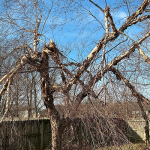
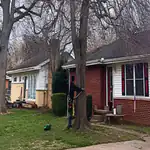
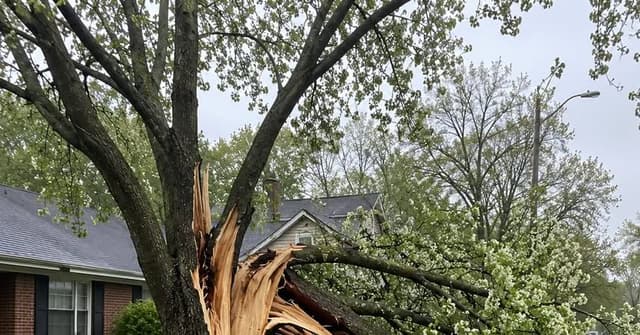
If you’ve driven around Evansville, Indiana after a spring storm, there’s a good chance you’ve seen it: a Bradford pear tree split cleanly in half, one or more major limbs down, sometimes the entire canopy splayed open like a book. It’s one of the most common storm-damage scenes every year, and it’s not a coincidence. Bradford pears are, structurally speaking, one of the more failure-prone ornamental trees planted in American yards, and Evansville’s storm patterns tend to find that weakness fast.
Here’s what’s actually going on with these trees, why they fail the way they do, and how to know when it’s time to have one removed before it fails on its own terms.
Why Bradford Pears Are Popular in the First Place
Bradford pear (Callery pear, Pyrus calleryana ‘Bradford’) became a landscaping staple across the Midwest and South for good reason: it grows fast, it’s covered in white blossoms every spring, it holds a tidy, symmetrical shape without much pruning, and it tolerates poor soil and urban conditions better than a lot of native species. For decades, it was a go-to choice for new subdivisions, commercial landscaping, and homeowners who wanted quick shade and spring color. The problem is that the same traits that made it popular fast growth and a naturally dense, uniform canopy are also what make it structurally weak.
The Real Reason Bradford Pears Split
The core issue is branch architecture. Bradford pears tend to grow multiple main branches from nearly the same point on the trunk, all at a narrow, upright angle. Arborists call this an “included bark” union instead of branches attaching to the trunk with a strong, wide-angle connection reinforced by wood; they grow so close together that bark gets pinched between them instead of solid wood fiber. That pinched bark never fuses into a strong structural joint. It’s essentially a permanent weak point.
- As the tree matures and those branches thicken, the narrow unions come under enormous stress every time wind pushes against the dense canopy.
- Add rapid growth Bradford pears can gain several feet of height a year when young and you get a tree that reaches a large, heavy canopy size well before its branch structure has had time to develop any real strength. It’s a mismatch between how fast the tree grows and how weak its skeleton actually is. This is different from most storm damage, where a healthy, well-structured tree loses a single limb under extreme wind.
- With Bradford pears, the whole tree is often built around several of these narrow, included-bark unions at once, which is why failures are frequently catastrophic: the tree doesn’t just lose a branch, it splits in half or loses its entire top.
Why Evansville Storms Are Especially Hard on Bradford Pears
Evansville’s climate delivers exactly the kind of conditions that expose this weakness.
- Spring thunderstorms bring high, gusty winds combined with heavy rain, which adds weight to a fully leafed-out canopy right at the time of year Bradford pears are often in full bloom or freshly leafed and at their heaviest, top-most growth.
- Saturated soil after heavy rain also reduces root anchorage, so even trees with a decent root system can shift or lean under wind load that a well-rooted tree in drier soil would handle fine.
- Add the fact that many Bradford pears in Evansville neighborhoods are now 20 to 30 years old right in the age range where those included-bark unions have had decades to grow thick and brittle and you have a lot of trees sitting right at the edge of failure, waiting for the next strong gust.
Warning Signs a Bradford Pear Is at Risk
A few signs tend to show up before a Bradford pear fails outright, though sometimes there’s very little warning at all:
- Multiple large limbs originating from nearly the same point on the trunk, especially at a narrow, upright angle.
- Visible cracks or splits at a branch union, even small ones, which indicate the bark inclusion has already started to separate under stress.
- A lean or shift in the canopy after a previous storm, suggesting the tree already sustained some structural damage.
- Dense, heavy growth concentrated at the outer edges of the canopy, which adds leverage and wind-catch exactly where the weak unions are least able to support it.
- A tree that’s already lost one major limb to a prior storm that’s often a preview of what’s coming for the rest of the structure.
Can Pruning Save a Bradford Pear?
Sometimes, to a point.
- If a Bradford pear is caught early, ideally within its first 10 to 15 years structural pruning to reduce the number of competing leaders and open up the canopy can lessen the load on the weakest unions and slow the tree’s tendency to split.
- Cabling can also provide some additional support for a mature tree with sentimental or landscape value, physically limiting how far a weak union can spread apart under wind load.
- Pruning and cabling manage the risk; they don’t fix the underlying issue.The included-bark unions are already there and won’t strengthen over time no matter how the canopy is shaped.
- For an older Bradford pear with several of these weak points already established, the honest answer is usually that structural work buys time rather than solving the problem, and it needs to be reassessed regularly.
When Removal Is the Right Call
- For a mature Bradford pear generally 15 years or older that already shows tight, included-bark unions across multiple limbs, or that has already split or lost a limb, removal is usually the safer and more cost-effective long-term choice.
- The tree’s structural weakness doesn’t improve with age; it gets worse as the limbs get heavier and the trunk grows around those pinched unions.
- Repeated cabling and pruning on a tree that’s fundamentally built this way can end up costing more over several years than a single, planned removal without eliminating the risk of a sudden, larger failure in the meantime.
- If a Bradford pear is close to your house, driveway, or a spot where family or pets spend time, that risk calculator shifts even further toward removal, especially heading into Evansville’s peak storm season each spring.
What to Plant Instead
If you’re removing a Bradford pear and want a replacement that won’t bring you back here in another 20 years, look at species with naturally stronger branch structure and better adaptation to Southwest Indiana’s climate oak, red maple, tulip tree, and eastern redbud are all solid choices that handle Evansville’s clay-heavy soil and storm patterns without the included-bark problem that defines Bradford pears.
Why Evansville Homeowners Trust Tree-B-Gone for Bradford Pear Removal
When a Bradford pear starts showing cracks, weak branch unions, or signs of previous storm damage, an experienced tree service firm in Evansville, Indiana like Tree-B-Gone can perform professional evaluation to help you make the right decision before the next major storm. We help homeowners identify Bradford pear trees vulnerable to splitting, especially those with cracks, weak branch unions, or previous storm damage. Our team assesses the tree and nearby property to determine the safest solution. If removal is needed, we use professional equipment and controlled techniques to safely clear the tree and address storm-related hazards.
Frequently Asked Questions About Bradford Pear Splitting by the Homeowners in Evansville, Indiana
Why do Bradford pears split instead of just losing a branch like other trees in Evansville, Indiana?
Because several major limbs typically grow from nearly the same point at a narrow angle, creating weak included-bark unions throughout the tree rather than just one or two vulnerable spots. When one gives way under stress, it often takes the rest of the structure with it.
How old does a Bradford pear need to be before it’s at risk?
Structural problems can start showing up as early as 10 to 15 years, and risk increases significantly from 15 to 25 years as the trunk and limbs thicken around the weak unions.
Is it worth cabling a Bradford pear instead of removing it?
It can be, for a young or moderately mature tree with real landscape value, but cabling manages risk rather than eliminating it. For an older tree with multiple weak unions, removal is often the more reliable long-term solution.
Do all Bradford pears eventually fail?
Not every single one, but the species’ branch architecture makes structural failure common enough that most arborists consider it a matter of when, not if, for a mature, unmanaged tree.
Will removing a Bradford pear near my house be covered by insurance?
Typically, proactive removal of a healthy-but-risky tree isn’t covered, though removal after storm damage to a covered structure usually is. Ask your insurer directly about your specific policy.
Summary Checklist: Is Your Bradford Pear at Risk?
| Situation | What to Check | What to Do |
| Multiple limbs from one point on trunk | Included-bark branch unions | Schedule a structural evaluation |
| Visible cracks at branch unions | Active separation under stress | Have it inspected before next storm |
| Tree is 15+ years old | Age-related structural decline | Prioritize evaluation, especially near structures |
| Previous storm damage or lost limb | Existing structural compromise | Assess remaining structure for removal need |
| Tree located near house or driveway | Consequence of potential failure | Weigh removal over repeated cabling |
Final Advice
Bradford pears aren’t a poorly maintained tree problem, they’re a structurally flawed species problem, and Evansville’s storm patterns are particularly good at finding that flaw. If you’ve got a mature Bradford pear on your property, especially one near your home, it’s worth having it evaluated before the next round of spring storms rather than after a limb comes down. Tree-B-Gone provides free, no-obligation estimates and can tell you honestly whether pruning will buy your Bradford pear more time or whether removal is the smarter long-term move.
Reviewed by Licensed Arborist
This article has been reviewed by a licensed arborist to ensure the information on Bradford pear structure, storm-related splitting, pruning, and removal reflects professional tree-care practices.