Key Takeaways
- Wood decay often starts inside a tree long before any visible symptoms appear.
- Wounds, storm damage, poor pruning, and root injury are the most common entry points.
- Trees can compartmentalize decay, which delays outward signs and hides the problem.
- Internal rot weakens trunks, branches, and roots even when the canopy still looks healthy.
- Moisture, humidity, and repeated storm stress accelerate hidden decay in Southwest Indiana.
- Professional inspection is the safest way to decide whether a tree can be preserved or should be removed.
Hidden decay is one of the most dangerous problems a tree can have because it usually develops out of sight. A tree may still look full, green, and stable while fungi are slowly breaking down the wood from the inside. In that sense, the tree can appear healthy long after its structural strength has already been reduced.
For property owners in Evansville and Southwest Indiana, that hidden progression matters because storms, rain, and wind can expose the weakness all at once. A tree that looks normal on a calm day may fail suddenly during the next heavy storm, especially if decay has already spread through the trunk or roots.
How Does Wood Decay Happen?
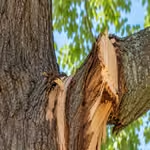
Wood decay usually starts when a tree’s outer defenses are breached. A broken limb, pruning cut, storm wound, mower injury, trenching damage, or crack in the trunk can expose wood beneath the bark and give fungi a way in.
Once that opening exists, decay organisms can begin colonizing the damaged tissue. They feed on parts of the wood that give the tree its strength, and the damage can slowly expand beyond the original wound.
Why the Decay is Often Invisible at First
Trees have strong natural defenses, and they do not usually fail the moment infection begins. Instead, they form barriers that try to isolate the damaged area and slow the spread of fungi.
This response can buy time, but it also makes the problem difficult to spot. A tree can continue growing and leafing out while the interior is becoming less stable, which is why visible symptoms often appear only after the decay has progressed significantly.
What Happens Inside the Wood
Decay does not affect every part of a tree in the same way. It may start in the sapwood, where water movement and living tissue are more active, or in the heartwood, where internal support is most important.
As fungi spread, they reduce the density and strength of the wood. That means the trunk and major limbs may still look solid from the outside while the inside has already been weakened enough to affect safety.
Sapwood Vs. Heartwood
Sapwood is the younger outer wood that moves water and nutrients through the tree. Heartwood is the older inner wood that no longer conducts water but still provides structural support. If decay enters the sapwood, it can interfere with the tree’s functioning and expand toward the core. If it reaches the heartwood, the tree may lose the strength that keeps the trunk and major limbs standing through wind and load.
The Role of Wounds
A wound is one of the most common ways decay starts. Tree bark is meant to act as a protective barrier, and once it is damaged, fungi have an easier path into the wood. Not all wounds are dramatic. Small pruning mistakes, repeated lawn equipment hits, or branch stubs left behind after storm damage can create long-term entry points that eventually allow decay to spread deeper into the tree.
Why Old Injuries Matter
An old wound may look harmless years later, but that does not mean the tree has fully recovered. Some damage never closes cleanly, and the exposed or weakened wood can remain vulnerable to decay organisms. This is why older trees with a history of storm breakage or poor pruning often deserve extra attention. The visible injury may be long gone, but the internal decline can continue quietly for years.
Root Decay is Especially Dangerous
Decay does not have to begin in the trunk. It can also begin in the root system, where it is even harder to notice without a close inspection. Root injuries from trenching, soil compaction, grade changes, or construction can weaken the tree below ground. When roots decay, the tree loses both anchorage and function. That makes the tree much more likely to lean, uproot, or fail during high winds and heavy rain, even if the canopy still looks healthy.
Moisture Speeds up the Process
Moisture is a major factor in hidden decay. Fungi tend to grow more readily in damp conditions, which means wet wood, poor drainage, and repeated storm saturation can make the problem worse. This is especially relevant in Southwest Indiana, where humid weather and seasonal storms can keep tree bases and root zones wet for long periods. Trees growing in poorly drained sites or clay-heavy soil may be especially vulnerable.
Why Can the Outside be Misleading
A tree with serious internal decay may still produce leaves and appear vigorous from a distance. That is one reason so many hazardous trees are overlooked until they begin showing obvious structural problems.
A healthy canopy does not prove the trunk is sound. A tree can keep leafing out while the interior wood is hollowing, cracking, or losing its load-bearing capacity.
Common late-stage signs
As decay progresses, the tree may begin to show more visible symptoms. These often include –
- fungal growth near the base
- cavities
- seams in the trunk
- dead limbs
- branch dieback, or
- a fresh lean
By the time these symptoms appear, the decay may already be advanced. That is why these signs should be treated as warning flags rather than minor cosmetic issues.
Why Storms Expose the Problem
Decay often becomes obvious only when the tree is stressed. Wind, rain, and ice all increase the force acting on a tree, and a weakened internal structure may no longer be able to handle that load. In Evansville and Southwest Indiana, that means a tree can seem fine until the next storm pushes it beyond its weakened threshold. Once that happens, failure can be sudden and severe.
What Homeowners Should Watch For
- Property owners should pay attention to wounds, mushrooms or conks at the base, cracks in the trunk, dead branches, and any change in lean.
- Soil heaving around the roots is another important sign, especially after heavy rain.
- If a tree near a house, driveway, or power line shows several of these symptoms, it should be treated as a hazard. The more structural signs appear together, the more urgent the evaluation becomes.
Why Professional Evaluation Matters
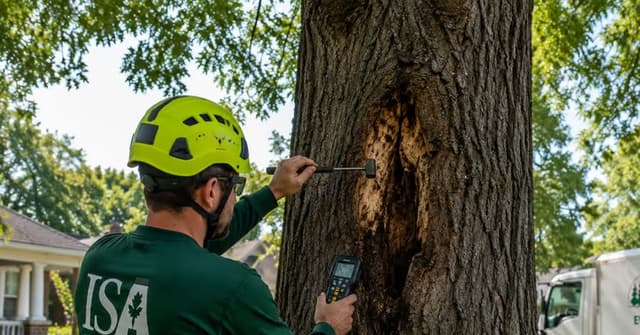
Hidden decay is difficult to judge from the ground. An experienced & professional tree service in Evansville, IN can look at the trunk, branch unions, roots, canopy, and surrounding site conditions to determine whether the tree is still structurally sound. That kind of assessment matters because the right response may be pruning, monitoring, or removal depending on the amount of decay and the risk of failure. Guesswork is not a safe strategy when the tree is large or close to a structure.
Tree-B-Gone helps Evansville homeowners address hazardous trees before they become emergencies. We are a locally owned, family-run company which provides fast response when a tree begins showing signs of decay or structural weakness. Our crews handle hazardous tree removal, tree trimming & pruning, tree cutting, and 24/7 emergency service across Evansville and Southwest Indiana.
Frequently Asked Questions About Wood Decay in Evansville, IN
When should a tree be removed in Evansville, IN?
If the trunk, roots, or major limbs are weakened enough to create a failure risk, removal is often the safest choice.
How can I tell if a tree has hidden decay?
Look for fungal growth, cavities, cracks, dead limbs, or a sudden lean, but remember that decay can exist even when the tree still looks healthy.
Can a tree survive with internal decay?
Yes, sometimes for years, but survival does not always mean the tree is structurally safe.
Does every wound cause decay?
No, but wounds are one of the main entry points for decay fungi and should be treated seriously.
Can internal wood decay spread to nearby healthy trees?
The decay itself does not spread directly from one tree to another, but the fungi that cause wood decay release spores that can infect other trees if they have fresh wounds or damaged bark.
Can pruning stop wood decay once it has started?
Pruning can remove decayed branches and reduce the risk of failure, but it cannot reverse decay inside the trunk or roots. A professional inspection is needed to determine whether the tree can be safely preserved.
Do mushrooms at the base of a tree always mean it needs to be removed?
Not always. Fungal growth often indicates internal decay, but the severity depends on the amount of structural damage and where the decay is located. A certified arborist or qualified tree professional should evaluate the tree before a removal decision is made.
How often should mature trees be inspected for hidden decay?
Large or mature trees should generally be inspected every one to three years, with additional inspections after severe storms or whenever new cracks, fungal growth, leaning, or branch dieback appear.
Summary Checklist: Warning Signs of Internal Decay and Tree Failure
| Sign or Condition | What It May Indicate | Recommended Action |
| Old wound or broken limb | Possible entry point for decay fungi | Monitor closely and inspect professionally |
| Fungal growth at the base | Active internal decay | Schedule an immediate evaluation |
| Hollow or soft trunk area | Internal wood loss | Treat as a structural warning |
| Sudden lean | Root failure or lower trunk weakness | Get a risk assessment promptly |
| Cracks or seams in trunk | Internal stress and structural compromise | Inspect before the next storm |
| Dead limbs in canopy | Reduced tree vigor or internal decline | Remove hazardous limbs and assess the tree |
| Soil heaving near roots | Shifting root plate or instability | Consider urgent evaluation |
| Sparse canopy | Root damage, decay, or transport issues | Investigate underlying cause |
| Multiple trunks with narrow unions | Weak attachment point | Evaluate for pruning, cabling, or removal |
| Proximity to a structure | Higher consequence if the tree fails | Prioritize professional inspection |
Final Advice
Trees rarely fail without warning. The challenge is that many of the first warning signs are hidden inside the wood, underground, or high in the canopy where property owners are least likely to notice them. If a tree on your Evansville property has a wound, fungus, a crack, or a history of storm damage, do not assume it is safe just because it still has leaves. Tree-B-Gone offers the local experience and equipment needed to identify hidden hazards and remove dangerous trees before they create damage. To get more information about how we can assist you, get in touch with our team now at (812) 714-1217 to Book Your Free Estimate.