
Evansville homeowners learn the hard way every summer that severe weather in the Ohio Valley does not give much warning. Straight-line wind events can develop in less than an hour. Tornadoes from supercell thunderstorms can drop with minimal lead time. The June 2012 derecho that swept across the eastern half of the country produced sustained wind damage that took weeks to clean up across Vanderburgh, Warrick, and Posey counties. Smaller storms cause property damage every year that does not make the news but adds up to millions in insurance claims across the Tri-State.
Key Takeaways
- Evansville and the surrounding Tri-State area see some of the most severe summer storm activity in the Midwest, with straight-line winds, derechos, and tornadoes possible from May through September.
- Tree trimming completed in late winter or early spring (February through early April) gives trees time to seal wounds before disease pressure peaks and before storms put weak branches to the test.
- Most storm damage to homes from trees is caused not by complete tree failure but by individual large limbs that were already weak before the storm hit.
- Insurance companies increasingly look at whether reasonable maintenance was performed when evaluating storm-related tree damage claims.
- Waiting until storms are in the forecast to schedule tree work is far too late. Reputable crews book out fast once active weather appears in the seven-day outlook.
The single most effective thing a homeowner can do to reduce storm-related tree damage to their property is to schedule professional tree trimming before storm season arrives, not during it. This article explains why timing matters specifically in the Evansville area, what proper pre-storm trimming actually accomplishes, and what the realistic window is for getting the work done.
Why Evansville Storms Are Particularly Hard on Trees
The Tri-State area sits at the intersection of several storm systems that drive its severe weather climate. The National Weather Service Paducah office, which covers Evansville and the surrounding counties, documents the region as having an extended severe weather season that effectively runs from late March through October.
The storm types most likely to drop trees and break branches in the area include:
- Severe thunderstorms with straight-line winds: Often producing sustained winds of 60 mph or more, with gusts well above that. These winds find weak branch unions and overloaded limbs.
- Derechos: Widespread, long-lived wind events that can affect hundreds of miles in a single pass. The 2012 derecho and several smaller events since have caused widespread tree damage across the area.
- Supercell thunderstorms and tornadoes: The Tri-State has been hit repeatedly by significant tornadoes, including the November 2005 event in Newburgh and Henderson and other tornadoes across southwestern Indiana.
- Heavy rain events with saturated soil: Trees in saturated ground uproot more easily when wind follows heavy rain.
- Hail: Damages bark and canopy, creating wounds and entry points for pests and disease.
Each of these storm types exploits specific weaknesses in trees. A tree with dead branches, weak unions, end-heavy limbs, or interior decay is far more likely to fail than a tree that has been properly maintained.
What Pre-Storm Tree Trimming Actually Accomplishes
Tree trimming before storm season is not aesthetic work. It is structural risk reduction. The specific things proper trimming addresses:
Deadwood Removal
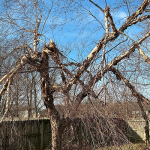
Dead branches do not bend in wind. They snap. Removing dead and dying limbs before storm season eliminates the projectiles that cause most roof, siding, and vehicle damage. Deadwood is often invisible from the ground but obvious when a trained crew climbs or works the canopy.
Weak Union Identification and Treatment
Branches that join the trunk at narrow angles, especially with included bark, fail predictably under wind load. Pre-storm work identifies these unions and addresses them through end-weight reduction or strategic pruning to redistribute load.
Crown Thinning to Reduce Wind Sail
A dense canopy catches more wind than a properly thinned canopy. Selective interior thinning reduces wind sail without reducing the tree’s appearance from the ground. Done correctly, this is one of the highest-impact storm preparation steps.
End-Weight Reduction on Long Limbs
Long horizontal branches act as levers. The longer the limb and the heavier the end, the more force acts on the attachment in wind. Reducing end weight on long limbs lowers the leverage and the failure risk.
Clearance From Structures and Service Drops
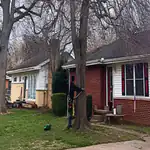
Branches touching or hanging near a roof, gutters, siding, or overhead electrical service create damage pathways in storms. Proper clearance work removes the contact risk before wind drives the branches into the structure.
The Right Window for Pre-Storm Trimming
| Period | Recommended For | Avoid |
| December through February | Heavy structural pruning, large limb removal | Severe cold snaps when wood is brittle |
| Late February through early April | Deadwood removal, crown thinning, hazard work | Pruning oaks after April 15 due to oak wilt risk |
| Mid-April through May | Light cleanup, fast-response hazard work | Major pruning on most species |
| June through August | Emergency response only | Routine work during peak storm season |
| September through November | Post-storm cleanup, light restorative work | Heavy pruning right before dormancy |
The late winter through early spring window matters for two reasons. First, most species can be pruned with the lowest disease transmission risk during this period. Second, completing the work before storms arrive gives trees time to begin sealing wounds before insect and pathogen pressure peaks in summer.
Oaks are a special case in the Tri-State. Oak wilt has been documented across southern Indiana by Purdue Extension and the Indiana Department of Natural Resources, and the recommendation is to avoid pruning oaks between April 15 and October 15 to reduce transmission risk by sap-feeding beetles. This narrows the oak pruning window further to late fall and winter.
Why Waiting Until Storms Are in the Forecast Does Not Work
Once active weather appears in the seven-day forecast, reputable tree services book out fast. The crews that have availability are often the out-of-area operators who follow storms, take deposits, and produce inconsistent results. Pre-storm scheduling means working with established local crews who know the area and have the equipment positioned for emergency response if needed.
The math on waiting is also unfavorable. The cost of pre-storm trimming on a mature tree is a fraction of the cost of post-storm cleanup, structural repair, and rework. Insurance claims add another layer of cost and complication, with deductibles, depreciation, and coverage limits that often leave the homeowner responsible for significant out-of-pocket expense.
What Insurance Companies Look At After Storm Damage
Homeowner insurance policies cover storm damage in most circumstances, but the details matter. Insurance adjusters increasingly look at whether the affected tree showed signs of pre-existing decline, deadwood, or structural defects that reasonable maintenance would have addressed. A tree that was visibly dead before the storm, or one that had been topped or otherwise damaged by prior bad pruning, may receive different treatment than a properly maintained tree that failed under exceptional storm conditions.
The documentation that helps a claim:
- Dated photos of the tree before the storm
- Records of professional inspections or maintenance work
- Documentation of any pruning, deadwood removal, or hazard mitigation
- Written estimates and invoices from prior tree service work
What We Commonly See In The Field
The most common pattern across the Tri-State after every major storm is the property where the damaged tree had visible problems that had been deferred for years. Dead branches that had been hanging in the canopy. Long limbs with no end-weight management. Cracks at major branch unions that had been growing for seasons. The storm did not create these problems. It found them.
The second pattern is the property where the homeowner called for a quote in May or early June, planning to schedule the work “soon,” and the first significant storm of the season hit before the work happened. By the time the call comes back, the work is no longer maintenance. It is emergency response, often after damage has already occurred.
The properties that come through storm seasons best are the ones whose owners scheduled annual or biannual professional inspections in late winter and addressed problems while they were still small.
What Evansville Homeowners Can Do Right Now
- Schedule a late winter inspection on every mature tree within striking distance of a structure, driveway, or gathering area
- Photograph trees from multiple angles for insurance documentation
- Address deadwood, weak unions, and end-weight problems before April 15
- Avoid topping or other destructive pruning practices regardless of how cheap the quote is
- Verify that any contractor carries general liability and workers compensation insurance, with certificates available directly from the insurance carrier before work begins
- Plan oak work for late fall and winter due to oak wilt risk
What not to do:
- Do not wait for storms to be in the forecast before scheduling
- Do not authorize topping or aggressive crown reduction in place of proper structural pruning
- Do not hire door-to-door contractors who appear after storms
Frequently Asked Questions
When is the best time to trim trees in Evansville?
Late winter through early spring (February through early April) for most species. Oaks should be pruned only during late fall and winter due to oak wilt transmission risk.
How much pruning is too much in one year?
Most professional standards recommend removing no more than 25 percent of the live canopy in a single year on a healthy mature tree. More aggressive cuts stress the tree and reduce its ability to recover.
Will trimming guarantee my trees survive a major storm?
No work can guarantee storm survival in extreme weather. Properly maintained trees, however, perform significantly better than neglected trees in the same storm and produce less collateral damage when failure does occur.
Does my homeowners insurance cover proactive tree trimming?
Generally no. Homeowner policies typically cover damage caused by storm events, not preventive maintenance. The maintenance is the homeowner’s responsibility.
How fast can a tree service respond after a storm in Evansville?
Response times vary widely depending on the storm scope and crew availability. Local crews that were not already engaged with their own storm cleanup typically respond within 24 to 48 hours for non-emergency situations. Genuine emergencies are handled faster.
Should I remove a tree that has had previous storm damage?
Depends on the type and extent of prior damage. Cracked unions, decayed pockets, and significant canopy loss often indicate that removal is the safer long-term option. A professional inspection can identify which trees can be saved and which should be planned for removal.
Can overgrown trees increase storm damage risk?
Yes. Overgrown limbs are more likely to break during high winds and can damage roofs, vehicles, fences, and power lines.
How often should trees be inspected in Evansville?
Most mature trees should be professionally inspected every 1 to 3 years, with annual inspections recommended for trees near homes or power lines.
What trees are most vulnerable during Indiana summer storms?
Large mature oaks, maples, Bradford pears, and trees with deadwood or weak branch unions tend to experience the most storm-related failures.
Schedule Your Evansville Tree Inspection Before Storm Season
Summer storms can arrive with little warning across Evansville and the Tri-State. A professional inspection can identify dead limbs, weak branch unions, and storm hazards before they become expensive emergencies.
Contact Tree-B-Gone today to schedule a tree assessment and prepare your property before severe weather season arrives.